
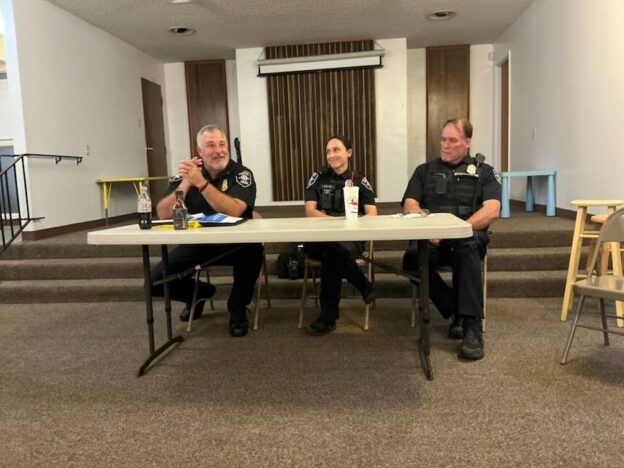
Thank you to everyone who came out on September 16 — and to Keystone Congregational Church for opening their social hall to us on short notice. Captain George Davisson of the Seattle Police Department’s North Precinct came without a slide deck, brought two of his officers, and stayed past his hour to answer everything the room had. Here’s what we took away, for the neighbors who couldn’t be there.

Wallingford, by the numbers
Capt. Davisson was candid that statistics only capture what gets reported. With that caveat, here is our neighborhood so far this year compared with the same stretch of 2025, from the City’s public crime data:
| Jan 1 – Sep 16 | 2025 | 2026 |
|---|---|---|
| Burglary | 94 | 116 |
| Larceny / theft | 283 | 281 |
| Motor vehicle theft | 79 | 61 |
| Robbery | 10 | 16 |
| Aggravated assault | 19 | 15 |
| Homicide | 1 | 0 |
In plain terms: property crime overall is flat, car theft is down meaningfully, and burglary is up — with a concentration along N 45th St. Robbery went from ten incidents to sixteen, an increase the Captain attributed largely to shoplifting that escalates when someone resists, which reclassifies the case. These are small numbers, and one active offender can move them a lot.
You can check any of this yourself on the City’s SPD Crime Dashboard — set the year to 2026 and the neighborhood to Wallingford.
What actually helps
- Report everything, every time. SPD’s analysts map every report down to the address, and that map decides where officers get assigned. Thefts that nobody reports don’t exist as far as deployment is concerned. “If you don’t call, we can’t get a report. We don’t know it’s a problem.”
- Don’t confront anyone. He described a call that began as a car prowl and ended with shots fired at the responding officer. Be a good witness from somewhere safe, and call it in.
- Monitored alarms and cameras get a fast response. A monitoring service reporting someone visible inside a home is a verified burglary, and officers respond immediately when they’re free.
- Small deterrents work. Burglars interviewed by detectives said they choose houses the same way: no dog, no alarm decal, an easy door. Car prowlers check door handles rather than break windows, because breaking glass draws attention.
- Use Find It, Fix It for litter, dumping and similar conditions. SPD officers use the same app.
The staffing math
Several neighbors asked why they don’t see more officers. The answer was arithmetic, not indifference. A brand-new officer takes about two years from application to working solo: the state academy, several weeks of Seattle-specific training, about four months of field training, then probation. An experienced officer hired from another department still takes over a year. The $50,000 lateral hiring incentive was recently discontinued, and the Chief is working to restore it. Roughly 100 officers were hired citywide this year, but retirements offset much of that. The citywide motorcycle unit went from around 40 officers to about five.
One arrest also takes an officer off the street for three to four hours — paperwork, evidence, and a jail run from the precinct furthest from the jail. A single business burglary can occupy four or five officers. North Precinct watches that were four to five officers below minimum staffing when Capt. Davisson arrived are now at or near minimum.
For our business district
Most of the reported activity on N 45th centers on a couple of blocks, and SPD’s heat maps show it. Store loss-prevention staff can detain shoplifters, though several chains have hands-off policies. Two things businesses may not know: a case where a suspect resists is increasingly charged as robbery, a felony — and someone formally trespassed from a store who returns can be charged with burglary. SPD has also run undercover retail-theft operations with store security elsewhere in the city. All of it depends on incidents being reported. Capt. Davisson also told us he has already assigned additional patrol attention to the 45th St business break-ins.
Big events at Gas Works — who controls what
SPD has no role in approving event permits. The City issues the permit; only then is SPD asked for staffing. Traffic plans, private security and parking enforcement are conditions written into the permit and scaled to the size of the event. Sound limits during an event are not an SPD function at all. If the scale of amplified events at Gas Works is your concern, the Captain’s advice was to take it to the City — the permitting process and your councilmember. WCC’s Gas Works oversight committee has been doing exactly that for three years and will publish a full season report this fall.
One bright spot: after repeated after-hours problems at Golden Gardens and Magnuson, SPD asked Parks to try private security during closed hours. Calls for service dropped to nearly zero, and SPD has asked Parks to repeat it next summer and add a roaming patrol.
Encampments
Officers can no longer ask someone camping to move along the way they once could — a single tent meets the definition of an encampment, and removals run through the City’s Unified Care Team: notice, offers of services, then a scheduled clearing with city crews. Jurisdiction complicates it further, since several local sites sit on state rather than city land. Neighbors raised a camp that has returned near John Stanford, and the Captain took the details. For problems that span agencies — wrong-way drivers, racing on I-5, fireworks, dumping — start with your councilmember’s office; the Captain will step in on escalations that need SPD pushing between city departments.
Sparkling Wallingford wants you
Janet Friday spoke about the Sparkling Wallingford Society, our neighborhood’s Adopt-A-Street group: about 50 volunteers, monthly cleanups focused on N 45th, roughly a ton of trash collected so far, and a shift toward longer-term beautification like the new planting bed in front of Harold’s. This fall they’re tackling the foxtail in the tree wells, a genuine hazard for dogs. Email us and we’ll connect you.
Next up: Wednesday, October 7
Our October meeting takes on Aurora Ave — the City’s planning and design study for redesigning the corridor — with SDOT’s project team invited to present and take questions. Start time 7:00 PM. We’ll confirm the location shortly — the board is still sorting out meeting space now that Good Shepherd’s larger rooms are being leased out.
WCC runs entirely on neighbors. Membership is $15 a year and it pays for the room, the insurance and the mailing list that put this conversation together. Join or renew, or just come say hello on October 7.