⚠️ Date Correction: An earlier version of this announcement listed the wrong day. The Waterway 20 kickoff is Wednesday, April 8 — not Thursday, April 9. We apologize for the confusion!
💧 This Wednesday — Waterway 20 Kickoff!
Hi Neighbors,
There’s a stretch of Lake Union shoreline on the west side of Gas Works Park in Wallingford that’s been closed to the public for decades — fenced off and awaiting environmental cleanup — that most people don’t even know about. That’s about to change!
The Wallingford Community Council has been awarded a 2-year grant from the Washington State Department of Ecology to bring the community into the investigation and cleanup of Waterway 20 — and to chart a path toward reopening public access to this priceless public waterfront.
Join us for the kickoff meeting to learn where things stand now, what’s planned for next steps, and how you can shape the outcome of this site.
📅 Wednesday, April 8, 2026
🕖 7:00 – 8:30 PM
📍 Gasworks Brewing 2441 N Northlake Way (Waterway 17)
This is the first of two public meetings this year. Your voice is needed as a part of the grant — literally! Come be heard. The future of Lake Union is calling you!
See you Wednesday! — Wallingford Community Council, Shorelines Committee
What proposed zoning near Neighborhood Centers & Transit Corridors could mean for Wallingford & Tangletown
Seattle is growing, and neighbors broadly agree: we need more housing.
But the decisions being made now will shape what kind of housing gets built — and whether Seattle continues to support family‑sized homes alongside studios and one‑bedroom apartments.
Why family‑sized housing must be part of the plan
Many neighbors support adding housing, including increased density near transit and shops. What’s missing from current proposals is a clear commitment to encouraging family‑sized housing — both rental and ownership.
No requirements or incentives for family‑sized homes in proposed Lowrise 3 (LR3) zoning
LR3 zoning most often results in studios and one‑bedroom units, because these maximize financial return under unlimited density
When zoning strongly favors small units and removes limits on unit count, larger homes with multiple bedrooms are less likely to be built
Seattle invests heavily in schools, parks, libraries, and neighborhood amenities. Residents want zoning choices that align with those investments by making room for households with children and multi‑generational families — not just smaller households.
What’s already been approved — Phase 1
On December 16, 2025, Seattle City Council passed CB 120993, permanently implementing Washington State’s HB 1110 Middle Housing law as Phase 1 of the One Seattle Plan.
This already added substantial housing capacity across Neighborhood Residential (NR) zones (formerly “single‑family”):
4–6 homes on most residential lots
Duplexes, triplexes, fourplexes, townhouses, cottage housing, and stacked flats
Increased flexibility near major transit
Subdivision options that allow ownership or shared land ownership
Seattle already has citywide opportunities for modest‑scale, family‑oriented housing growth.
What’s being decided now — Phase 2
City Council is now considering Phase 2 zoning legislation (March 19 – June 18, 2026) focused on:
Neighborhood Centers (30 citywide)
Frequent transit corridors
Expanded Lowrise and Neighborhood Commercial zoning
Two public hearings:
Monday, April 6
Thursday, May 29
Why Wallingford & Tangletown neighbors are concerned
Wallingford transit corridors
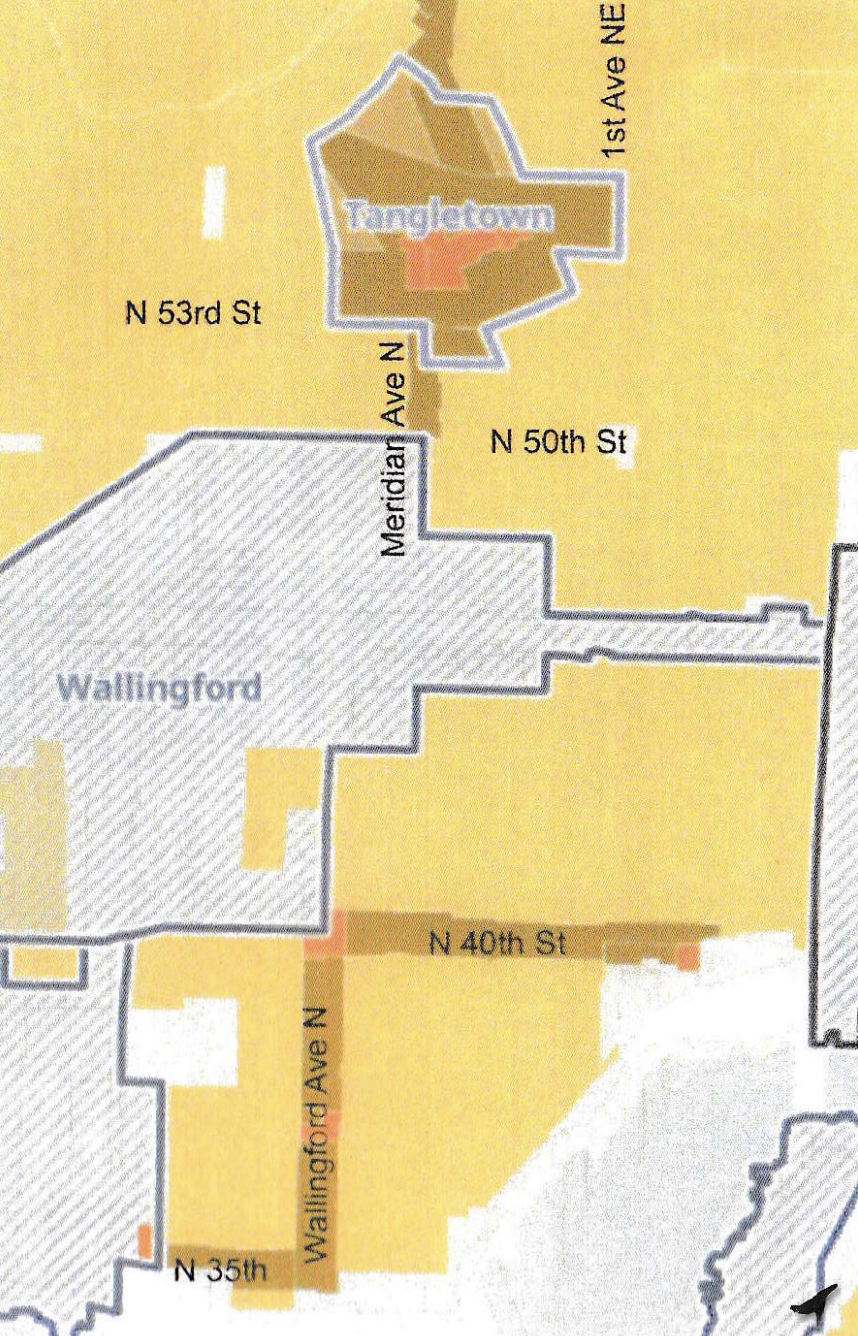
Along frequent bus routes 31, 32, and 62, proposals would rezone over 30 blocks of current Neighborhood Residential streets currently zoned NR — those facing Meridian Ave N, N 40th Street, Wallingford Ave N, and N 35th Street — from NR to Lowrise 3 (LR3) zoning.
These blocks currently support 1–2 story homes, duplexes, small 2–3 story apartments, courtyard‑scale housing, and sixplexes. Under proposed LR3 zoning, these same lots could be redeveloped with:
5‑story apartment buildings
No limit on number of units
80% lot coverage
5‑foot front setbacks
The concern is that existing family‑sized homes and apartments could be replaced with predominantly studio and one‑bedroom units, without encouraging 3-4 bedroom units, reducing opportunities for families to live along these corridors.
Tangletown Neighborhood Center
In Tangletown, Phase 2 proposals would:
Eliminate all Neighborhood Residential zoning within the proposed Neighborhood Center
Rezone roughly 400 residential lots from NR to LR3
Allow 5‑story buildings adjacent to 1–2 story homes
Remove unit caps and significantly reduce shared outdoor space
The result could be the loss of existing family‑sized housing without creating comparable family‑friendly replacements.
This isn’t about saying “no” to growth
It’s about aligning growth with community needs. Residents across Wallingford and Tangletown support more housing near shops and transit, reducing sprawl and car dependence, and welcoming new residents citywide.
What they’re asking for is intentional zoning that supports both smaller households and families, rather than zoning that strongly encourages studios and one‑bedroom apartments by allowing unlimited units per lot to maximize building yield.
Is there a middle path? Yes.
Neighborhood Residential (NR) zoning offers a balanced approach — designed to add housing while supporting everyday neighborhood life:
Encourages stacked flats and family‑sized homes
Allows 3–4 story buildings (height cap at 3 stories, with a stacked‑flat exception up to 42 feet / approx. 4 stories)
Maintains front setbacks and 50% lot coverage for daylight, trees, gardens, and social space
Includes unit caps, making family‑sized homes more feasible
Supports growth while keeping neighborhoods welcoming and livable
Community members support retaining NR zoning in Neighborhood Centers like Tangletown and along neighborhood‑scale transit corridors where buildings are currently 1–3 stories. This approach allows Seattle to add homes without losing family‑friendly housing choices.
Why speak up
These decisions are being made now. Hearing from residents who support housing growth thoughtfully helps the City Council make better choices.
A short email, phone call, or public comment makes a difference!
How to make your voice heard
1. Show up
Attend the Monday, April 6 City Council meeting at City Hall and sign up to speak.
Post this on your block’s message board. Forward it. Hand it to a neighbor.
Suggested message to send to elected officials
Feel free to personalize this — even a few sentences in your own words make a stronger impact than a form letter.
Subject: Support Family‑Friendly Housing in Neighborhood Centers & Corridors
Dear Councilmember [Last Name],
I am a resident of Wallingford, and I’m writing about the proposed zoning changes in Neighborhood Centers and along corridors like Meridian Avenue N, N 40th Street, Wallingford Avenue N, and N 35th Street.
I support building more housing in Seattle, including near neighborhood‑serving business districts. The question is what kind of housing gets built, where, and at what scale — especially now that state law already creates substantial opportunities for new homes citywide. I want our neighborhoods to remain welcoming to both current residents and the next generation of families.
Family‑sized homes, including family‑sized rental homes, are increasingly hard to find in Seattle. Without intentional zoning, families can be priced out — even though access to Seattle’s schools, parks, and neighborhood amenities is a major reason families want to live here.
I’m concerned that the proposed expansion of Lowrise 3 (LR3) zoning extends beyond Neighborhood Center cores into surrounding residential streets, while not requiring or encouraging family‑sized homes, meaningful front setbacks, or gradual height transitions. LR3 zoning allows 5‑story buildings, up to 80% lot coverage, 5‑foot front setbacks, and no limits on units per lot — which strongly incentivizes studios and one‑bedroom units, and results in open space being pushed to private rooftop decks instead of shared, street‑level green space.
I encourage the Council to consider a more balanced approach by prioritizing Neighborhood Residential (NR) zoning in and around Neighborhood Centers and along neighborhood‑scale corridors. NR zoning already allows 4–6 homes per lot, encourages stacked flats and family‑sized units, and preserves setbacks for daylight, trees, and shared outdoor space.
Seattle can add housing and remain a place where families can live, grow, and stay. Thank you for considering this perspective.
Sincerely, [Your Name] [Your Address or Neighborhood]
For more information
Attend the WCC Meeting — Wednesday, April 1, 2026 at 7 PM, Good Shepherd Center, Room 202
April brings the wonderful colors of spring flowers along with fresh challenges to be addressed on citywide rezone proposals with the restart of Phase 2 Comp Plan legislation. There is a compressed timeline with only 2 meetings left and two public hearings between March 19–June 18. There will be amendments by Council representatives and voting in June.
It is now a reality that EVERY Neighborhood Residential (NR) lot—formerly single family—due to passage of the permanent Middle Housing legislation CB 120993 on December 16, 2025 in Phase 1, has increased capacity to allow building of 4–6 housing units on 5,000 square foot lots citywide. Phase 2 proposals under Council review include changes to Lowrise 1, 2, 3 zones, Neighborhood Commercial, and Midrise zones add more zoning layers to increase housing unit capacity per lot.
The most important contribution you can make is to use your voice at Public Hearings—either remotely or in person—and by contacting City Council representatives directly to advocate for your neighborhood.
WCC is excited to announce our Annual Board Meeting Election night will be held Tuesday, May 5. Our keynote speaker will be an Assistant Police Chief from the Seattle Police Department. To be eligible to vote for Board positions, you must pay your WCC 2026 membership dues before the April 12–13 deadline at wallingfordcc.org. Thank you to those of you who support us with new and renewed memberships and donations.
If you would like to be considered for a board position, please contact our nominating committee at pres@wallingfordcc.org.
Warm regards, Bonnie Williams, President — Wallingford Community Council
📅 Upcoming WCC Meeting
Next General Meeting
📅 Wednesday, April 1, 2026 | 7:00 PM – 8:30 PM 📍 Good Shepherd Center, Room 202 | Seattle, WA 98103
Agenda:
Phase 2 Zoning Update: Preview ahead of April 6 Public Hearing
WCC Board Updates & Community Announcements
Waterway 20 Kickoff — April 8 at Gasworks Brewery
Dan Strauss Community Meeting — March 25 (Wed). Contact Dan.Strauss@seattle.gov or 206-684-8806.
City Council has restarted Phase 2 of the Comprehensive Plan with a compressed schedule running March 19 through June 18, 2026. This process will determine rezoning for Neighborhood Residential lots facing frequent transit bus corridors and 30 new neighborhood centers citywide—including Wallingford and Tangletown.
Key Phase 2 Dates
Date
Time
Event
March 19, 2026
2:00 PM
Select Committee Meeting (completed — video available)
Background: State Zoning Compliance (HB 1110) — Phase 1
The City Council passed Permanent State Zoning Compliance legislation CB120993 on December 16, 2025, effective January 21, 2026. The legislation comprehensively updates Seattle’s Neighborhood Residential (NR) zones—formerly single-family zones—to comply with Washington State HB 1110.
HB 1110 requires cities to allow a wider variety of “middle” housing types, including duplexes, triplexes, and stacked flats, in single-family zones. The state mandates that the densest housing be located near major transit (light rail and Rapid Ride). Middle housing is defined as buildings compatible in scale, form, and character with single-family houses that contain two or more attached, stacked, or clustered homes—including duplexes, triplexes, fourplexes, sixplexes, townhouses, stacked flats, courtyard apartments, and cottage housing.
NR zones now have a density limit of 4–6 units per 5,000 square foot lot and a 32 foot / 3 story height maximum, with the exception of stacked flats at 42 feet / 4 stories.
What Phase 2 Proposes
Mayor Harrell’s One Seattle Plan has been controversial since its introduction in October 2024. Key concerns have focused on the scale of proposed housing growth—330,000 units, far beyond the Environmental Impact Study requirement of 80,000–120,000 units over 20 years—and questions about affordability and adequate public outreach.
OPCD has primarily proposed Lowrise 3 (LR3) zoning of 5–6 stories for NR lots facing bus corridors and NR lots surrounding 30 proposed neighborhood centers. Critics argue LR3/5–6 stories is out of scale with existing neighborhoods unlike NR zone 3 story heights and goes beyond what HB 1110 requires.
The March 19 meeting introduced additional proposals for changes to Lowrise 1–3 categories and Midrise zones, including a new 6-story Midrise zone. The proposed development standard changes to Lowrise 1 and 2 for greater heights, if passed, will change lowrise zones across the city—including the 2019 conversions of 750 lots from single family to Lowrise 1, 2, 3 inside the Wallingford Urban Village (now Center). In 2019, 45th and Stoneway were upzoned to 4–8 stories, which has led to significant apartment development around Stoneway in just 7 years.
Key Areas Impacted in Wallingford
Bus Corridor Map – Wallingford zoning impact areas
Wallingford Ave & N. 40th St. (Routes 31/32): LR3 proposed from I-5 along 40th to Wallingford Ave N., south to N. 35th St. and across to Stoneway.
Tangletown Business Core: NC-40 → NC-55–65 (5–6 stories).
Surrounding Tangletown: ~400 NR homes proposed for LR3 (5-story).
Meridian Avenue N. (Route 62): NR corridor from N. 50th to N. 56th proposed for LR3 (5-story).
Public Meeting #1: Wed April 8, 7–8:30 PM at Gasworks Brewery Public Meeting #2: Tentatively Thu May 26, 7 PM, Venue TBD
The WCC’s two-year grant from the WA Dept of Ecology (2026–2028) is moving forward. Two public outreach meetings are scheduled to reopen access to Lake Union through the fenced-off area just west of Gas Works Park known as Waterway 20.
Committee chaired by Ted Hunter is hiring consultants for soil contamination analysis.
🗳️ May 5 Annual Meeting & Board Elections
Tue May 5, 7–8:30 PM Good Shepherd Center Chapel (Top Floor)
Special Speaker: Assistant Police Chief, Seattle PD
Membership dues must be paid by April 12–13 to vote. wallingfordcc.org or mail check to 4108 Midvale Avenue North, Seattle 98103.
Community Updates — Seattle Neighborhood Alliance
WCC President Bonnie Williams attended the first meeting of a new networking organization for Seattle Community Council leaders, held at Doric Lodge in Fremont in mid-March. This coalition is a support group for strengthening operations of Community Councils citywide. There is no political alignment at this time. Members are encouraged to seek help and share expertise on website design, recruitment of members, and more effective neighborhood outreach.
🗓️ 2026 Meeting Schedule
April 1 (Wed)
General Meeting, Good Shepherd Room 202
May 5 (Tue)
Annual Meeting & Board Elections, Good Shepherd Chapel. Police speaker.
June 3 (Wed)
General Meeting
Jul–Aug
Summer break
🙋 Volunteer
Secretary: Needed urgently to take meeting minutes through May election
Gasworks Park Monitor (2–3 volunteers): Help track event impacts this summer
Legislative Liaison: Track state bills through the legislative session
Mark your calendar for our Wednesday, March 4 community meeting at 7:00 PM at Good Shepherd Center. We have two important presentations — a Seattle Tree Code overview from a certified arborist, and an update on the Lincoln Athletic Field at Lower Woodland Park presenting community-proposed alternatives to Seattle Public Schools’ current plan.
We also have significant breaking news: City Council has announced the Phase 2 Select Committee Meeting Schedule, running March 19 through June 18, 2026. This process will determine rezoning for Neighborhood Residential lots facing bus corridors citywide — including key areas in Wallingford and Tangletown. Details are below, and we will keep you updated as this moves forward.
Warm regards, Bonnie Williams, President — Wallingford Community Council
📅 March 4 Community Meeting
Wednesday, March 4, 2026 • 7:00 PM • Good Shepherd Center, Room 202
1. Seattle Tree Code — Overview & Q&A
Certified ISA Arborist Alec Johnston and team will present an overview of the Seattle Tree Code and answer questions on the latest 2023 update. Bring your questions about trees on your property or in your neighborhood.
2. Lincoln Athletic Field at Lower Woodland Park
Erik Fisk of Friends of Lower Woodland Park (friends.lwp@gmail.com) will present community-proposed alternatives to Seattle Public Schools’ proposed Option A design for a Lincoln High School athletic field at Lower Woodland Park.
Seattle Public Schools is proposing to add a playfield for Lincoln High School at Lower Woodland Park by way of a design they call “Option A.” Over 400 people have now endorsed a petition asking SPS to reject Option A due to adverse impacts, including how Option A overcrowds the playfield area, severs pedestrian park access, generates hazardous user conflicts, wastes recent infrastructure investments, and destroys historic trees.
As an alternative, the community has proposed Option C to distribute the new field to the underutilized gravel parking lot near 50th and Aurora. SPS has not responded to Option C directly, but has expressed some concerns. The community has responded with variations such as C1, C2, and D to explore specific configurations and alternative sites. These alternatives and updates will be presented at the meeting, followed by Q&A.
City Council has announced the Phase 2 Select Committee Meeting Schedule, running March 19 through June 18, 2026. This will govern the review of proposed Comp Plan legislation for Neighborhood Residential (NR) rezoning of lots facing frequent transit bus corridors and 30 new neighborhood centers citywide — including Wallingford and Tangletown.
Date
Time
Event
Thursday, March 19, 2026
2:00 PM
Select Committee Meeting
Monday, April 6, 2026
9:30 AM
Public Hearing
Friday, May 29, 2026
9:30 AM
Public Hearing
Thursday, June 4, 2026
1:00 PM
Select Committee Meeting
Thursday, June 18, 2026
1:00 PM
Select Committee Meeting
Online maps allow you to check the proposed zoning status for your property:
The City Council passed Permanent State Zoning Compliance legislation CB120993 on December 16, 2025, effective January 21, 2026. The legislation comprehensively updates Seattle’s Neighborhood Residential (NR) zones — formerly single-family zones — to comply with Washington State HB 1110.
HB 1110 requires cities to allow a wider variety of “middle” housing types, including duplexes, triplexes, and stacked flats, in single-family zones. The state mandates that the densest housing be located near major transit (light rail and Rapid Ride). A city must allow 6 of the 9 defined types of middle housing to meet the required density threshold. Middle housing is defined as buildings compatible in scale, form, and character with single-family houses that contain two or more attached, stacked, or clustered homes — including duplexes, triplexes, fourplexes, sixplexes, townhouses, stacked flats, courtyard apartments, and cottage housing.
What is Proposed
Mayor Harrell’s One Seattle Plan has been controversial since its introduction in October 2024. Key concerns have focused on the scale of proposed housing growth — 330,000 units, far beyond the Environmental Impact Study requirement of 80,000–120,000 units over 20 years — and questions about affordability and adequate public outreach.
The Office of Planning and Community Development (OPCD) has primarily proposed Lowrise 3 (LR3) zoning of 5–6 stories for NR lots facing bus corridors and NR lots surrounding 30 proposed neighborhood centers. Critics argue LR3/5–6 stories is out of scale with existing neighborhoods and goes beyond what HB 1110 requires. OPCD has returned with updated online maps showing some boundary changes for neighborhood centers, but the LR3/5-story proposal for bus corridors appears largely unchanged and rezones NR lots surrounding the Tangletown business core.
Key Areas Impacted in Wallingford
Wallingford Ave & N. 40th St. (Routes 31/32): The LR3 (5-story) zone is proposed to stretch from I-5 along 40th Street to Wallingford Ave N., continuing south to N. 35th St. and across to Stoneway.
Tangletown Business Core: Proposed to change from NC-40 (current) to NC-55–65 (5–6 stories).
Surrounding Tangletown: Approximately 400 homes currently zoned NR (3-story scale) are proposed for LR3 (5-story).
Meridian Avenue N. (Route 62): The corridor of NR-zoned homes and small rentals from N. 50th St. to N. 56th St. is proposed for LR3 (5-story).
📋 City Council & Relevant Contacts
The following contacts are relevant to Phase 2 as the Select Committee process moves forward. Additional information on how to engage will be shared after the March 4 meeting and ahead of upcoming public hearings.
WCC meets the first Wednesday of each month at 7:00 PM, Good Shepherd Center, Room 202 (exceptions noted below).
Date
Topic
March 4, 2026
Tree Code Overview (Alec Johnston) + Lincoln Athletic Field Update (Erik Fisk)
April 1, 2026
Lake Union Waterway 20 Grant introduction (soil cleanup & public outreach) + Phase 2 Zoning Update ahead of April 6 Public Hearing
May 6, 2026
Annual Board Election (date may shift slightly)
June 3, 2026
Waterway 20 Grant public outreach + Phase 2 Zoning Update
🙋 Volunteer — Get Involved
Secretary: Temporary Volunteer Needed (through May 2026)
We are looking for a volunteer to serve as Secretary through May 2026, keeping accurate meeting minutes. This is a great way to stay connected with your community.
The Wallingford Community Council promotes quality of life in the Wallingford and Tangletown neighborhoods of Seattle. We welcome all neighbors to our monthly meetings. (WCC Membership renewals need to be completed by mid April to be eligible for the May Board election meeting.)
On January 29, the City released Phase 2 of the Comprehensive Plan, titled “Centers and Corridors,”. Zoning proposals for “Neighborhood Centers” and “Frequent Transit Corridors.”
The verdict: The City has largely ignored the extensive community feedback to develop a zoning plan that is compatible with lower scale neighborhoods like Wallingford and Tangletown provided over the last year. The Phase 2 proposal is nearly a carbon copy of the massive upzoning first seen in October 2024 as part of Phase 1. The Phase 2 maps just released fail to incorporate requested comments and measures to scale back and blend new zoning codes with existing streetscapes or ensure compatibility with our neighborhood’s character.
Significant changes are proposed for Wallingford and Tangletown in Phase 2 with a focus of rezoning for 30 new neighborhood centers and along “frequent transit” corridors citywide.This legislation will drastically overhaul residential zoning, ending single-family zoning and shifting towards much denser multi-family living, even on very small lots.
A timeline for the City Council’s Phase 2 review legislative process is not yet available.
What is Proposed
The new Phase 2 maps propose upzoning many single-family and residential lots to LR3 (Lowrise 3). This allows for 5-story apartment buildings (50 feet tall) with unlimited density—a drastic shift from our current residential zoning.
Key Areas Impacted:
Wallingford Ave & N 40th St (Routes 31/32): The 5-story (LR3) zone is proposed to stretch from I-5 along N 40th St to Wallingford Ave N, continuing south to N 35th St and across to Stone Way.
Tangletown: The business core is slated for NC-55 (55 feet), with surrounding single-family blocks south to 54th St upzoned to LR3 (5-story).
Meridian Ave N (Route 62): The corridor of homes and small rentals from N 50th St to N 56th St is proposed for LR3 (5-story).
Between October, 2024 and the present, there have been 20 Select Committee meetings, 4 Public Hearings, and multiple other opportunities for the City Council and the Office of Planning and Community Development (OPCD) to adjust the Phase 1 proposal for better compatibility with the existing streetscapes.
On February 12, 2025, the WCC hosted a highly attended monthly meeting that included OPCD’s Director Rico Quinindongo and Michael Hubner, as well as an observer, D4 representative Maritza Rivera. During this meeting, many residents provided in-person feedback, expressing concerns that the proposed rezones for Wallingford and Tangletown bus routes were out of scale with the neighborhood’s existing homes, apartments, and businesses.
Specifically, comments about the oversized map that included an excessive number of blocks around the Tangletown business core—justified only by an infrequent, minor bus route—were ignored. Residents also voiced concerns that the extreme upzone proposals would drive displacement and increase property taxes. This in-person neighborhood feedback, however, appears to have been dismissed, judging from the Phase 2 maps.
📅 VITAL MEETING: Wallingford Community Council
We need a packed room to respond to this proposal.
Wednesday, February 4
Time: 7:00 PM – 8:30 PM
Location: Good Shepherd Center, Room 202
This is our opportunity to organize. We will review the maps in detail and discuss how to get the City’s attention to incorporate messages and feedback that we provide in the coming Phase 2 months of the Comprehensive plan.
Agenda Item: Deep Dive on OPCD Phase 2 Re-Zoning Impact
Examine the Office of Planning and Community Development (OPCD) map tool to understand the specific, lot-by-lot effects of the Phase 2 maps.
Discussion of Resolution 32183 adopted as part of the Comp Plan final passage of CB 120, which includes neighborhood maps proposed during the amendment process. These maps have been deferred for further environmental study and will be addressed as unfinished business.
Review Phase 1 Adoption
Phase 1 included the Comprehensive Plan policies (CB 120985) for shaping growth and the permanent compliance legislation (CB 120993) to implement rules for HB1110 Middle Housing within Neighborhood residential zones.
The City Council adopted Phase 1 on December 16, 2025, and it took effect on January 21, 2026. The legislation also includes Resolution 32183, which defers consideration of an additional Environmental Impact Statement (EIS) and Neighborhood Center Maps for a future date. More details here
Agenda Item: Advocacy Strategy and Action
Call to Action: Residents are strongly encouraged to participate in spreading the word through flyer distribution to increase advocacy.
Engagement: Stay informed by tracking the Select Committee’s actions on Phase 2.
Participation: Get involved by attending open houses (by district) and public hearings.
Outreach: Communicate with City Council and OPCD representatives via phone and email.
Neighborhood Focus: It is critical for the community to come together to consider the comprehensive, big-picture impacts, especially on our neighborhood arterials.
Agenda Item: WCC Board Business – 2026 Project Priorities
The Wallingford Community Council (WCC) is moving forward on the following key projects for 2026:
Phase 2 Re-Zoning: Tracking developments, advocacy, and community outreach.
Waterway 20 Grant
Gasworks Park Concert Mitigation: Continuing the 2024 collaboration with Gasworks Park Administrators to mitigate the impacts of the 4-5 largest amplified commercial summer music concerts.
✅ Community Updates & Wins
Waterway 20 Grant Secured
While we fight for zoning, we are also protecting our shorelines. The WCC has secured a two-year grant (2026–2028) from the Washington State Department of Ecology to address soil contamination at Waterway 20. The committee will hire consultants and host two info sessions this year.
Funding: Funds will be used to address soil contamination at Waterway 20.
Action: We will hire consultants to analyze soil conditions and develop mitigation methodologies.
Updates: The committee, chaired by Ted Hunter, will host two information sessions this year to share findings.
Gas Works Park Oversight
Our committee is working to mitigate the impact of large commercial events (10k+ crowds) on the surrounding neighborhood. After two years of negotiations, we are making progress on noise compliance and parking enforcement.
Volunteer Need: If you live near Gas Works Park, we need 2-3 volunteers to help monitor events this summer.
🗓️ Save the Date: 2026 Meeting Schedule
Mark your calendars for the first Wednesday of the month:
Feb 4 (This Week!)
March 4
April 1
May 6 (Tentative – Annual Board Election)
June 10 (Note: 2nd Wednesday)
📢 Call for Volunteers
The Wallingford Community Council (WCC) encourages residents to become more involved in neighborhood advocacy. This includes:
Following Legislation and Advocating: Participating in public hearings and assisting with the distribution of flyers to inform the community about the latest zoning proposals.
Current Open Volunteer Roles:
Secretary: A volunteer is urgently needed to keep accurate minutes of the WCC’s monthly meetings until the board election in May.
WCC Gasworks Park Committee (2-3 Volunteers): We are looking for 2-3 people to help for a few hours this summer, especially those who live near Gasworks Park. Superintendent of Parks Diaz has praised the WCC’s work and expressed a desire to continue our partnership this summer.
Legislative Liaison: A volunteer is desirable to report on bills during the state legislative session (which runs through mid-March in 2026). This is important because Seattle taxpayers are often losing local control on legislation related to housing, transit, and encampments (e.g., HB1110, which mandated 4-6 units per lot).
How to Get Involved:
Volunteer: Contact pres@Wallingfordcc.org to express your interest in a role.
Membership: Annual memberships run from January-December. You can find membership information at Wallingfordcc.org.
📂 Resource Guide: Key Contacts
The transition to Mayor Katie Wilson in early January has resulted in many Department Head and City Council changes. We hope the comprehensive key resource guide from our last meeting notice will help facilitate your ability to connect with decision-makers at the city, state, and county levels.
The City Council is planning to form a Full Council Select Committee soon to review the proposed Phase 2 legislation. This new Comprehensive Plan Phase 2 Select Committee will establish a meeting schedule for the full Council, providing opportunities for community engagement with the city.